Personal Essay · 9 min read · June 1, 2026
Why I Quit Calm and Headspace (And What Finally Stuck Instead)
If you've ever downloaded Calm or Headspace with genuine hope — and then quietly deleted them three weeks later — you're not a failure at meditation. You're in an enormous, barely-discussed majority. A systematic review of mindfulness app trials published in Behaviour Research and Therapy found a pooled dropout rate of 13.1% just within the controlled window of a research study, where participants have extra incentive to stay [1]. In the real world, Apptopia data puts Headspace's 30-day retention at just 7.65% and Calm's at 8.34% — meaning roughly 9 in 10 people who download these apps are effectively gone within a month [2]. This essay is about why that keeps happening, and what a different kind of design can do instead.
- The scale of the problem: Calm and Headspace have been downloaded a combined 213 million+ times as of 2023, yet fewer than 1 in 10 users remain active after 30 days [2][3].
- Streaks are the culprit: Research shows users who prioritize unbroken streaks are 3.2× more likely to quit tracking entirely after a single missed day [4].
- The psychology is clear: Habit science from Wendy Wood and BJ Fogg points to the same conclusion — external scorekeeping eventually undermines the intrinsic reward that makes a behavior stick [5][6].
- Short sessions work: Seven minutes is genuinely enough; the science behind brief, consistent practice is solid (see our deep-dive at /blog/7-minute-morning-meditation-science).
- One-line journaling amplifies it: Pairing a guided session with a single written intention anchors the feeling in a way that a streak counter never can [7].
- A quieter design wins: Apps with no subscription pressure and no habit dashboards may retain users precisely because they remove the performance anxiety.
| Dimension | Calm / Headspace | A No-Streak Alternative |
|---|---|---|
| Business model | Annual subscription ($69–$100/yr) | No subscription |
| Engagement mechanic | Streaks, badges, progress dashboards | None — just today's session |
| Session length pressure | Variable; encourages longer courses | Fixed 7-minute daily session |
| Journaling | Optional / add-on | One-line prompt, built in |
| 30-day retention (reported) | ~7–8% [2] | Designed to remove quit triggers |
| Primary feeling on miss | Streak broken → shame spiral | Nothing lost → come back tomorrow |
TL;DR: The apps aren't failing you — their engagement mechanics are. Replacing gamified scorekeeping with a quiet 7-minute session and a single journaling prompt removes the exact triggers that cause most people to quit.
The Dropout Numbers Nobody Talks About
Millions of Downloads, Barely Any Meditators
The meditation app market looks like a success story from the outside. Calm racked up 133 million downloads in 2023; Headspace collected 80 million [3]. Combined, those numbers are staggering. But downloads are not practitioners. They're installs — most of which gather digital dust within weeks.
The data beneath the headline figures is sobering. Apptopia found that the average 30-day retention rate across Android mental health apps sits at just 3.3% [2]. Headspace and Calm outperform that average, but only to 7.65% and 8.34% respectively [2]. In other words, even the best-performing apps in the category lose more than 91% of their users before the first month is out.
A peer-reviewed systematic review and meta-analysis — covering randomized controlled trials that measured engagement with mindfulness apps — found that app dropout was significantly higher than dropout from control conditions, with an odds ratio of 1.78 (95% CI: 1.39–2.28) [1]. That's a remarkable finding: people were measurably more likely to disengage from the app-based intervention than from having no intervention at all.
What Happens After the New-Year Download
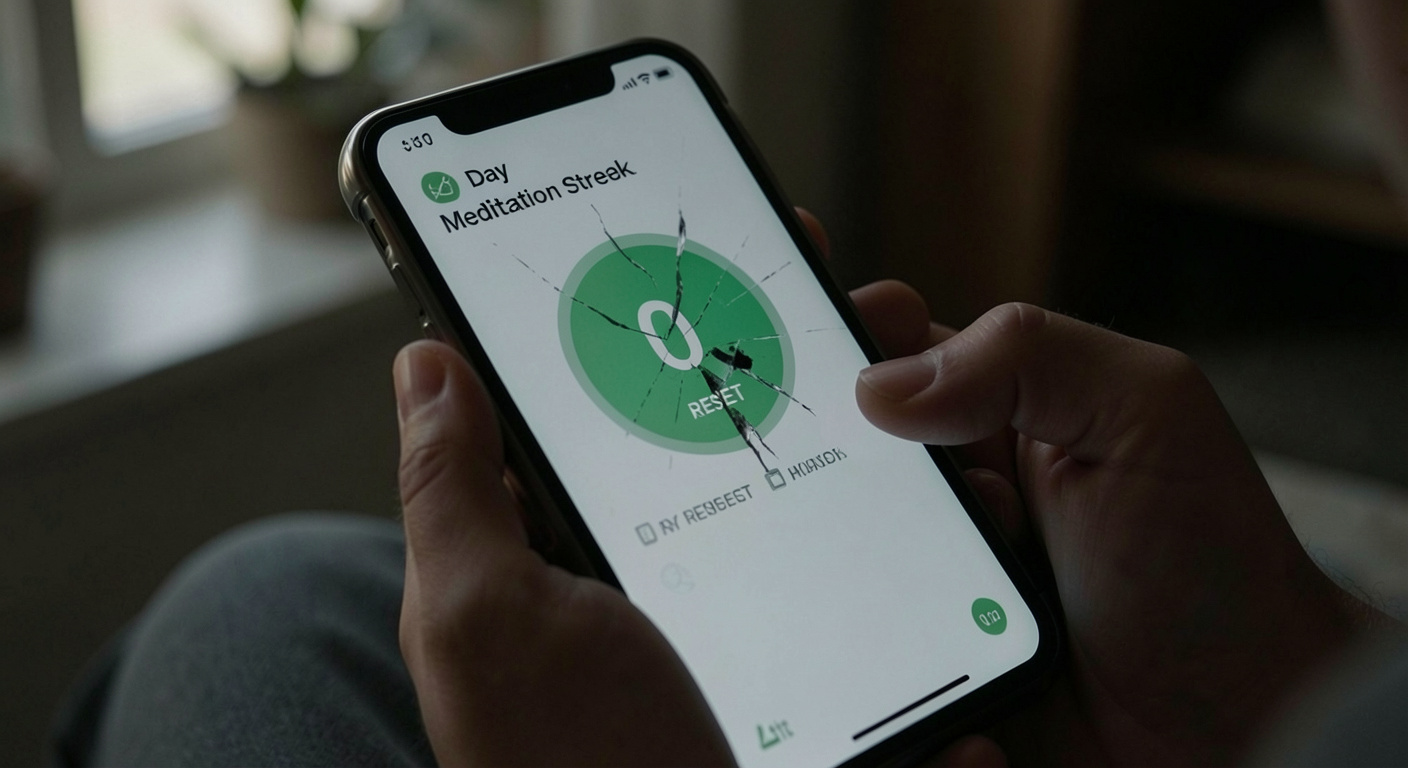
The pattern is depressingly predictable. January. A resolution. A download. The first few sessions feel genuinely good. Then life happens — you miss a Tuesday. The streak counter rolls back to zero. Something that felt like self-care begins to feel like a report card. The app gets pushed to page three of your home screen, then off it entirely.
This isn't anecdote. It's the dominant user journey. And it has almost nothing to do with whether the guided meditation inside the app is high quality. Headspace's and Calm's actual meditation content is well-produced, clinically informed, and genuinely useful. The problem is the shell around that content: the subscription reminder, the streak badge, the "you're on a 4-day streak — don't lose it!" push notification.
Why Streaks Backfire: The Behavioral Science
The Threat-Based Neurobiology of Broken Streaks
Streak mechanics are borrowed from video game design, where they work reasonably well because the stakes are low and the context is explicit entertainment. Apply the same mechanic to a personal well-being practice and you introduce a threat structure into what should be a restorative experience.
A 2023 longitudinal study following 412 adults who used streak-focused wellness apps for 18 months found that participants who prioritized maintaining unbroken streaks were 3.2× more likely to abandon tracking entirely after a single missed day compared to those using process-oriented, non-linear systems [4]. The mechanism is threat-based neurobiology: when a streak breaks, the brain processes it as a failure event, triggering self-criticism and — in some cases — learned helplessness around the behavior entirely [4].
The irony is complete. The feature designed to keep you meditating is the feature most likely to make you stop.
Wendy Wood on What Actually Makes Habits Stick
Wendy Wood, professor emerita of psychology and business at the University of Southern California and one of the world's foremost habit researchers, has spent decades studying why intentions don't become behaviors. Her conclusion, published in the Annual Review of Psychology, is that "much of human behavior is driven by automatic routines shaped by context rather than conscious intention" [5].
"People are most likely to form habits when contexts promote easy repetition and when the behavior itself is rewarding." — Wendy Wood, Professor Emerita of Psychology, University of Southern California [6]
This is the key insight that most meditation apps miss. Wood's research emphasizes that rewards must be immediate to wire a behavior into automatic habit — but that those rewards can and should be intrinsic to the behavior itself [6]. The feeling of calm after a seven-minute breathing session is an immediate intrinsic reward. A streak counter badge is a delayed, external one. The former wires the habit. The latter creates a performance relationship with it.
When the external reward (the streak) disappears — because you traveled, because you got sick, because you overslept — there's nothing underneath it to sustain the behavior.
BJ Fogg and the Moment Streaks Should Stop
BJ Fogg, director of the Behavior Design Lab at Stanford and author of Tiny Habits, describes streaks as potentially useful scaffolding — but only early and only temporarily. According to the Tiny Habits framework, "once the habit becomes automatic (you'd feel weird not doing it), stop tracking the streak. At that point, the behavior is intrinsically rewarding. The streak has done its job." [7]
The problem with Calm and Headspace is structural: the streak never stops. It's a permanent feature, not scaffolding. The apps' business models depend on daily re-engagement, so the external motivator stays front and center indefinitely — crowding out the internal one that's actually trying to form.
"Think of streaks as scaffolding during the first 30–90 days. Once the habit becomes automatic, stop tracking the streak." — Cohorty Blog, summarizing BJ Fogg's Tiny Habits framework [7]
This is why users who do develop a genuine meditation practice often describe eventually ignoring the streak counter — or turning off notifications entirely. They found the intrinsic reward despite the app's mechanics, not because of them.
What a Quiet Alternative Actually Looks Like
Removing the Performance Layer
What would a meditation app look like if it were designed around Wendy Wood's and BJ Fogg's actual findings rather than gaming metrics? It would be short enough that friction is near zero. It would deliver an immediate, intrinsic reward (the feeling of the session itself). It would have no streak counter to break. And it would have no subscription renewal email to resent.
This is not a novel idea — it's what the research has been pointing toward for years. Insight Timer, the free-to-use app, commands 63% of all time spent on meditation apps in the US, according to Sensor Tower industry data [8]. The leading retention and engagement figure isn't the most gamified app. It's the free one that focuses on the practice rather than the performance metrics.
The lesson: remove the subscription anxiety, remove the streak pressure, and the practice gets a chance to speak for itself.
The 7-Minute Window
Seven minutes is not a compromise. It's an intentional design choice grounded in cognitive load research, and you can read the full case at /blog/7-minute-morning-meditation-science. But for our purposes here: a session short enough to do before your first coffee removes the "I don't have time today" rationalization entirely. That excuse is the second most common quit trigger, right behind broken-streak shame.
| Quit Trigger | How Traditional Apps Handle It | A 7-Min No-Streak App Handles It |
|---|---|---|
| "I broke my streak" | Streak counter stays broken; guilt persists | No streak to break |
| "I don't have time" | 10–20 min courses; encourages longer sessions | Fixed 7 minutes, every day |
| "The subscription isn't worth it" | Annual renewal reminder | No subscription |
| "It feels like homework" | Progress bars, badges, completion rates | One session, one prompt, done |
| "I forgot" | Push notifications tied to streaks | Gentle, no-shame daily reminder |
One Line Changes the Day
The journaling component is not an afterthought. Pairing a guided session with a single written intention — one sentence about how you want to move through the day — creates what Wood's research calls a context-behavior link: a small, immediate cognitive anchor that connects the post-meditation feeling to a specific intention [6]. You can explore the neuroscience behind this practice in detail at /blog/one-line-journaling-morning-intention.
Where a streak counter measures consistency (a lagging indicator of habit), a one-line journaling prompt measures meaning — which is a leading indicator of the intrinsic reward that will eventually make the habit automatic.

Making the Switch: A Practical Transition
If You're Mid-Subscription on Calm or Headspace
First: the content in both apps is genuinely good. This is not a screed against their guided sessions. If you have time left on a paid subscription, use it — specifically for the unguided sleep sounds, the single-session anxiety relief tools, and any body-scan content you like. Those features deliver immediate intrinsic rewards without requiring a 30-day course arc.
What to stop using: the streak counter. Turn off the "daily streak" notifications. Close the progress tab. Use the app as a meditation tool, not a habit tracker. Notice whether that changes your relationship with it.
Choosing Your Next Move
If you're done with subscriptions entirely, the comparison at /blog/calm-vs-headspace-vs-no-subscription-meditation-apps breaks down the full landscape of alternatives — including free-tier options and apps that have deliberately removed gamification mechanics.
The checklist for evaluating any replacement is simple:
- Session length: Can I realistically do this seven days a week, every week of the year?
- Subscription model: Does missing a payment affect my access or add mental overhead?
- Engagement mechanics: Does the app measure my performance, or just deliver the practice?
- Post-session anchor: Is there something small — a prompt, a word, a single sentence — that carries the feeling into the day?
If the answer to that last question is yes, you've found something structurally different from what you quit.
The Simplest Possible Morning
The research is unified on one point: the conditions that build lasting habits are low friction, consistent context, and immediate intrinsic reward [5][6]. A 7-minute guided session at the same time each morning, followed by one sentence written in a journal, satisfies all three. No scoreboard required.
That's the design philosophy behind this app. No subscription. No streaks. Just today's session, today's prompt, and the quiet feeling that follows. Try today's session free — and if you miss tomorrow, there's no counter to reset. Just come back the day after.
Frequently asked questions
Why do most people quit Calm and Headspace so quickly?▾
Research shows that roughly 92% of users stop engaging with Calm or Headspace within the first 30 days. The primary culprits are streak-based mechanics that turn a self-care practice into a performance metric, subscription pressure that adds financial guilt, and session lengths that feel unmanageable on busy days. When a single missed day resets a streak counter, the brain processes it as failure — triggering shame and disengagement from the behavior entirely.
Are meditation streaks actually bad for building a habit?▾
According to habit researchers including Wendy Wood and frameworks like BJ Fogg's Tiny Habits, streaks can be useful scaffolding in the very early stages of habit formation. The problem is that apps keep the streak mechanic permanent, which means external motivation never gives way to intrinsic reward. A 2023 longitudinal study found users who prioritized unbroken streaks were 3.2× more likely to quit entirely after a single missed day.
Is 7 minutes really enough time to meditate?▾
Yes — and the brevity is a feature, not a limitation. Seven minutes is short enough to eliminate the 'I don't have time' rationalization while still being long enough to produce measurable physiological calm. Consistent short sessions over time are more effective than occasional long ones for building an automatic habit. See our full breakdown of the science at /blog/7-minute-morning-meditation-science.
What is one-line journaling and why does it work with meditation?▾
One-line journaling means writing a single sentence of intention immediately after your meditation session — something like 'Today I want to move through challenges with curiosity rather than frustration.' This creates what habit researchers call a context-behavior link: a small cognitive anchor that connects the calm feeling of the session to a specific intention for the day. It takes under a minute and dramatically increases carry-over into daily behavior.
What meditation app should I use if I'm burned out from Calm and Headspace?▾
Look for an app with a fixed short session length (7 minutes is ideal), no subscription model that adds renewal pressure, no streak counter or performance dashboards, and some kind of post-session anchor like a journaling prompt. Insight Timer is a popular free alternative. Our own app was built specifically around these principles — try today's session free at no cost and with no subscription required.
How do I stop feeling guilty about missing a meditation day?▾
The guilt comes from the app's design, not from you. Streak counters are borrowed from video game engagement mechanics and are specifically engineered to create loss aversion — the feeling of dread when a number might reset. Once you remove the streak counter from the equation, a missed day is simply a missed day: neutral, not a failure. Returning the next morning costs nothing. Designing your practice around this principle is the fastest way to build a durable habit.
Sources
- Rates of attrition and engagement in randomized controlled trials of mindfulness apps: Systematic review and meta-analysis
- Self-guided mental health apps aren't cost-effective… yet — EA Forum (Apptopia 30-day retention data)
- Top meditation app statistics you need to know in 2024 — BigOhTech
- Are Psychology-based Habit Trackers More Effective Than Streak Counters For Long-term Weight Maintenance
- Wendy Wood helps people apply the science of habits in everyday life — APA Monitor
- Wendy Wood (psychologist) — Wikipedia
- The Psychology of Streaks: Why They Work (And When They Backfire) — Cohorty Blog
- User Retention Gamification Examples: Insight Timer 63% US time share — StriveCloud (citing Sensor Tower)
Keep reading
Ready to see it for yourself?
Back to home →